
Around 1,200 BCE, the eastern Mediterranean experienced one of the most catastrophic collapses in human history. Within a few decades, nearly every major civilization in the region fell. The Hittite Empire disintegrated. Mycenaean Greece collapsed. The city of Ugarit was destroyed and never rebuilt. Egypt survived, but barely. Even the mighty Assyrians struggled.
And in the middle of it all, the Egyptian records mention a confederation of attackers they called "the Sea Peoples."
What The Egyptians Said
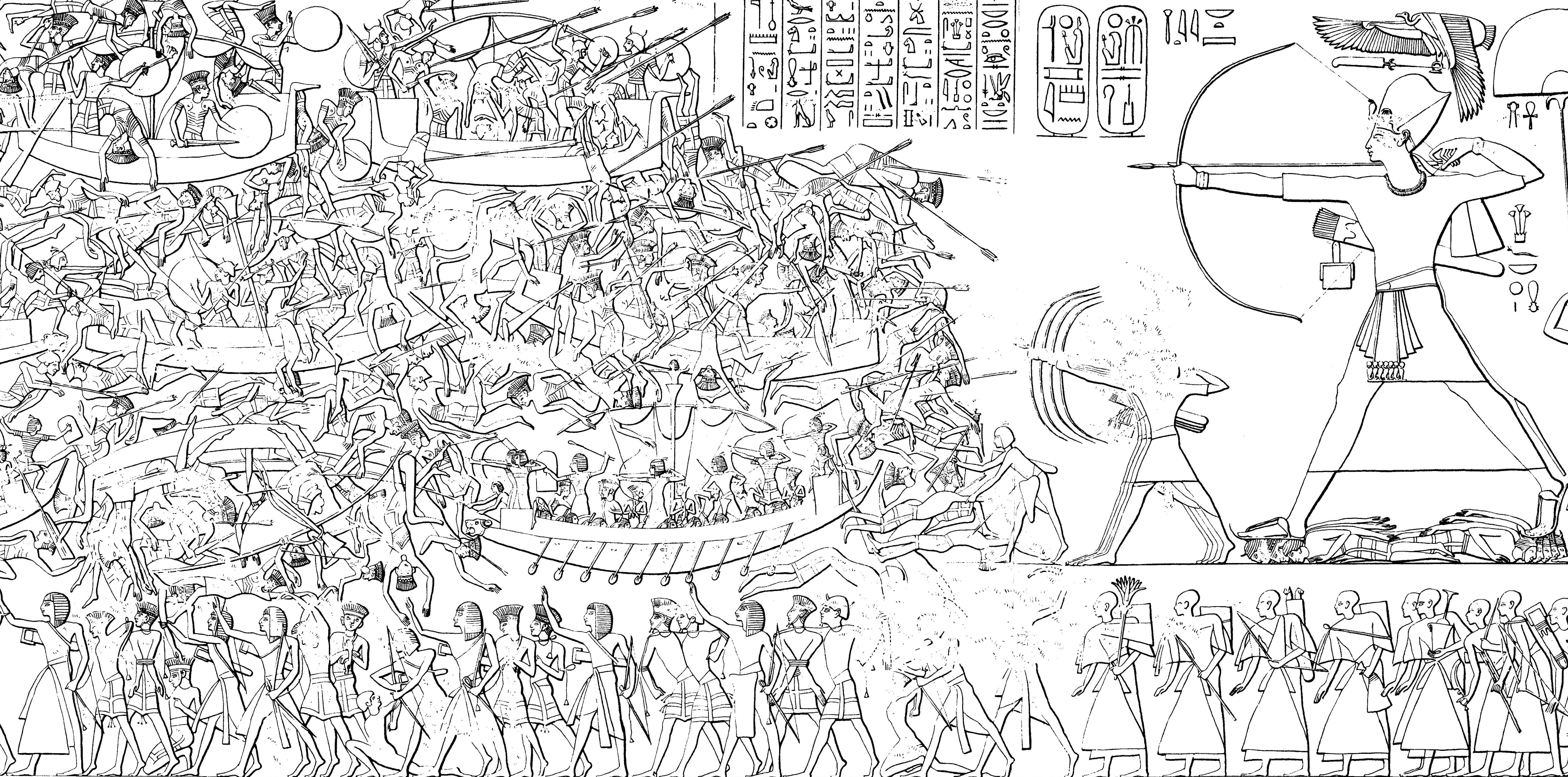
The main sources are inscriptions from the mortuary temple of Ramesses III at Medinet Habu, dating to roughly 1,178 BCE. The texts describe a coalition of groups, including the Peleset, Tjeker, Shekelesh, Denyen, and Weshesh, who swept through Hatti (the Hittite Empire), Arzawa, Cyprus, and the Levant before reaching Egypt's borders.
Ramesses III claimed victory over them. The temple reliefs show naval and land battles in vivid detail. The Sea Peoples are depicted with distinctive headgear, horned helmets, feathered headdresses, fighting from ships and ox-carts with women and children alongside warriors.
That last detail is important. These were not raiders looking for plunder. They brought their families. They were migrating.
Who Were They?
This is where honest scholarship meets honest uncertainty. We have names from Egyptian records. We can sometimes match those names to known peoples. The Peleset are almost certainly the Philistines, who settled the coast of what is now Gaza and southern Israel. The Shekelesh might be Sicilians. The Denyen might be connected to the Greek Danaans.
But "might" is doing a lot of work in those sentences. The identifications are based on phonetic similarities between Egyptian transliterations and known ethnic names. That method has limits. We are reading Egyptian consonantal spellings and guessing at the vowels, then matching the result to names from other traditions.
Some of the groups remain entirely unidentified. The Weshesh, for example, have no widely accepted identification. They appear in the records, fought at the battle, and then vanish from history.
Did They Cause The Collapse?
The old narrative was straightforward: Sea Peoples invaded, civilizations fell. But modern scholarship has moved away from single-cause explanations. The Bronze Age collapse was likely the result of multiple overlapping crises.
A prolonged drought appears in climate proxy records. Earthquakes destroyed several cities. Trade networks that connected Egypt, Greece, Anatolia, Cyprus, and the Levant fragmented. Internal rebellions and social upheaval are documented in some areas.
The Sea Peoples may have been as much a symptom as a cause. If drought and economic collapse displaced populations across the Mediterranean, then the "invasion" may have been a mass migration of desperate people, pushed from their homelands by the same forces that were weakening the empires they collided with.
What We Do Not Know
Quite a lot. We do not know where all the Sea Peoples originated. We do not know the precise sequence of events. We do not know whether the groups acted as a coordinated alliance or simply moved through the same region at the same time. We do not know how much of the destruction attributed to them was actually caused by them versus by earthquakes, drought, or internal revolt.
The Bronze Age collapse remains one of the most debated events in ancient history precisely because the evidence is fragmentary and the causes were almost certainly multiple. Anyone who offers a clean, simple narrative is probably oversimplifying.
The Bronze Age collapse and the identity of the Sea Peoples remain subjects of active archaeological debate. New discoveries, including ongoing excavations at Hattusa and analysis of ancient DNA from Philistine sites, continue to revise our understanding.