
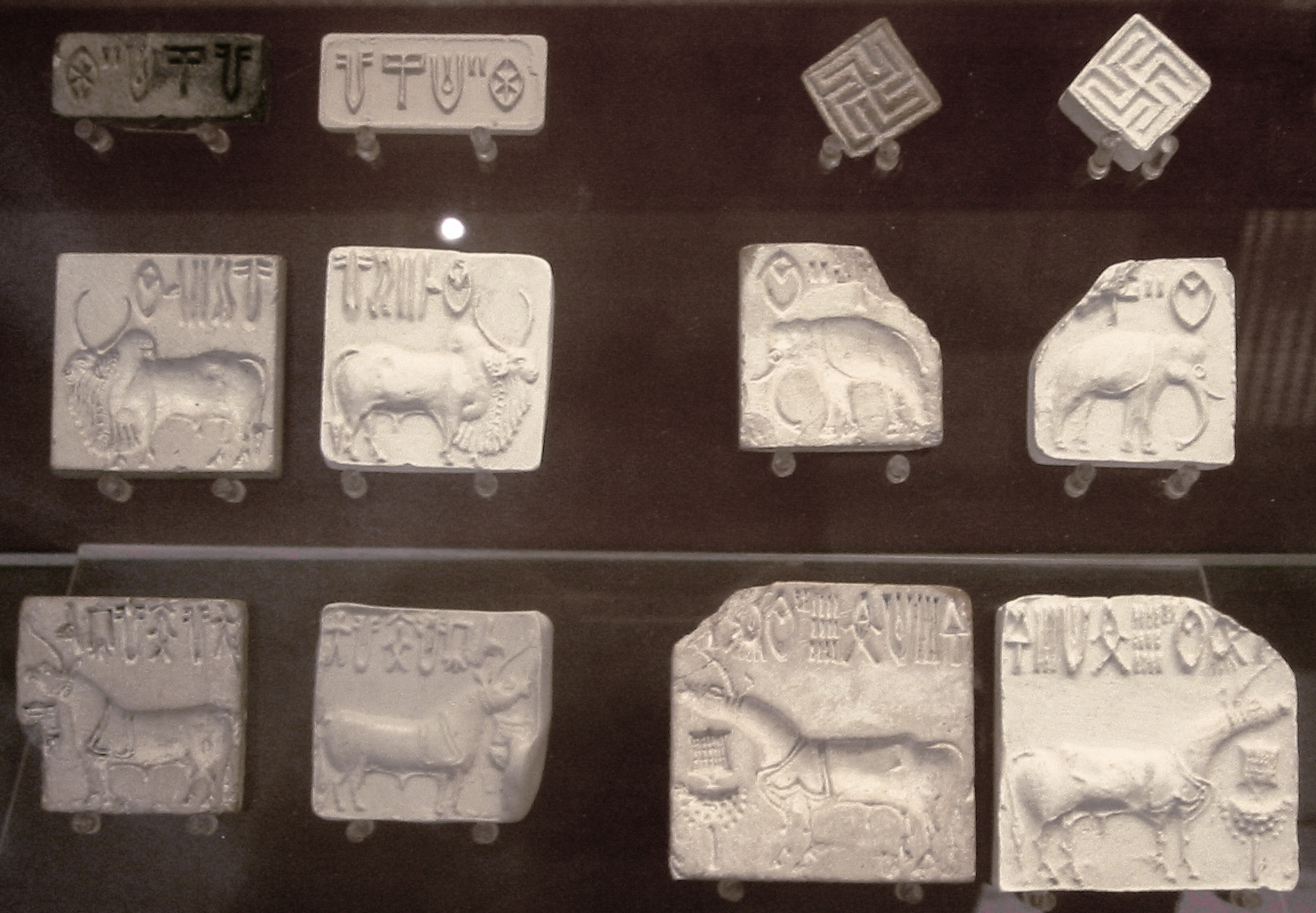
The Indus Valley Civilization was one of the largest in the ancient world. At its height around 2,500 BCE, it covered an area larger than ancient Egypt and Mesopotamia combined. Its cities, Mohenjo-daro and Harappa among the best known, had sophisticated urban planning: grid streets, standardized brick sizes, advanced drainage systems, public baths.
And we cannot read a single word they wrote.
The Script
The Indus script appears on thousands of artifacts, mostly small soapstone seals. These seals typically show an animal figure (a bull, a unicorn-like creature, an elephant, a rhinoceros) alongside a short sequence of symbols. Over 400 distinct signs have been cataloged.
The average inscription is about five symbols long. The longest known inscription contains just 26 symbols. That brevity is part of the problem. There is not enough text to perform the kind of statistical analysis that helped crack Egyptian hieroglyphics or Linear B.
We do not know what language the script represents. We do not know if the symbols are logographic (representing words), syllabic (representing sounds), or something else entirely. We do not even have consensus on whether it qualifies as a full writing system or something more limited, like a system of emblems or property markers.
Why It Remains Undeciphered
Deciphering an unknown script usually requires one of three things: a bilingual inscription (like the Rosetta Stone), knowledge of the underlying language, or a large enough corpus to find patterns through statistical analysis. The Indus script offers none of these.
There is no bilingual text. The Indus civilization had trade contacts with Mesopotamia, and Mesopotamian records mention a place called "Meluhha" that may refer to the Indus region, but no translation key has been found.
The underlying language is unknown. Some scholars argue for a Dravidian language, others for an early Indo-Aryan language, others for a language family that has since gone extinct. Each camp has published proposed decipherments. None has achieved widespread acceptance.
And the corpus, while numbering in the thousands, consists mostly of very short texts. You cannot build a grammar from five-symbol strings.
What We Can Infer
Despite not being able to read the script, archaeologists have learned a great deal about the civilization through its material culture. The standardization is striking. Bricks across hundreds of sites maintain the same proportional ratio. Weights follow a binary and decimal system. This suggests centralized standards, if not centralized government.
The cities show no obvious palaces or royal tombs. No monumental statues of kings. No battlefield murals. This has led some scholars to suggest a more egalitarian social structure, or at least one where power was not displayed through the architectural vocabulary that other ancient civilizations used.
But we should be careful with arguments from absence. Maybe the palaces were built of wood and did not survive. Maybe the kings displayed power in ways we do not recognize. Without the written record, we are interpreting architecture, and architecture can be misleading.
A Civilization Without a Voice
The Indus Valley Civilization lasted roughly 700 years as a major urban culture before declining around 1,900 BCE, likely due to a combination of climate change, river shifts, and economic disruption. Its people did not disappear. They dispersed, and their cultural DNA almost certainly lives on in South Asian traditions. But their specific voice, their history as they understood it, remains locked behind symbols we cannot read.
Every few years, someone announces a breakthrough. So far, none has held up to peer review. The script remains one of the great unsolved puzzles of archaeology, and honest scholars will tell you that it may never be deciphered without a dramatically larger discovery of texts.
The Indus script remains undeciphered as of 2026. Claims of decipherment appear periodically but have not achieved scholarly consensus. The interpretations above reflect the current mainstream understanding, which is itself subject to revision.