

Cats Are Killing Endangered Hawaiian Monk Seals Through Toxoplasmosis and Nobody Will Say It
There are roughly 300 Hawaiian monk seals left in the main Hawaiian Islands. That is the entire breeding population of one of the most endangered marine mammals on Earth. And the leading disease-related killer of these animals? A parasite that comes from cat feces.
Toxoplasma gondii reproduces exclusively in the intestinal tract of cats. A single infected cat can shed hundreds of millions of oocysts — microscopic parasite eggs — into the environment through its waste. Those eggs survive in soil and water for up to two years. When it rains on Oahu, where an estimated 300,000 feral cats roam freely, the runoff carries those eggs into streams, storm drains, and straight into the Pacific Ocean. Monk seals ingest the parasite through contaminated water or infected prey. And then they die.
100 Percent Fatality Rate
As of NOAA's most recent count, 15 Hawaiian monk seals have been confirmed dead from toxoplasmosis. Every single seal diagnosed with the disease has died. There is no successful treatment. There is no vaccine. Not for the seals, not for the cats, not for any infected animal. When a monk seal contracts toxoplasmosis, it is a death sentence.
"Toxoplasmosis appears to affect more females than males, which concerns population recovery since breeding females are critical." — NOAA Fisheries
In 2018, three monk seals on Oahu were found dead from toxoplasmosis within a single week. One of them, a young male named RKC1 (nicknamed Sole), had been born on the cliffs of Kalaupapa, Molokai. He made it to the beaches of windward Oahu before the parasite got him.
The Birds Are Dying Too
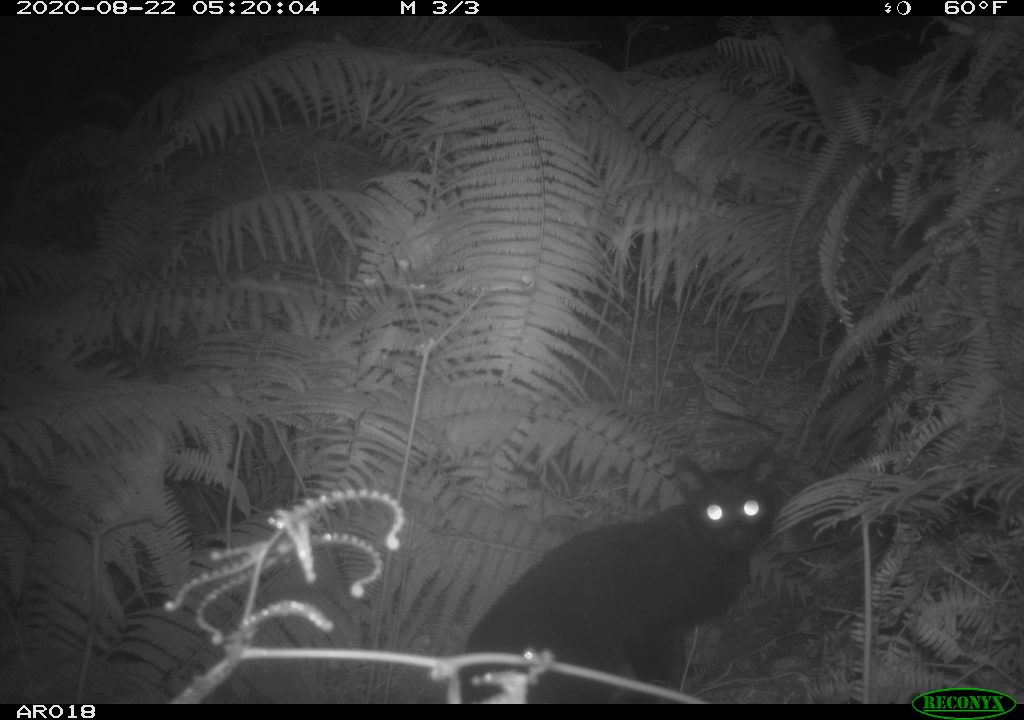
Monk seals are not the only casualties. Feral cats have been caught on infrared trail cameras dragging endangered Hawaiian Petrel chicks from their ground-nesting burrows on Kauai. In August 2020, a single feral cat killed nine endangered Hawaiian Petrel chicks in three days in the Hono o Na Pali Natural Area Reserve. At the Kauai National Wildlife Refuge Complex, cats killed at least 237 endangered native birds in a single year, including Hawaiian moorhen, Hawaiian coot, Hawaiian stilt, and koloa maoli.
The nene, Hawaii's state bird, once numbered 25,000. Europeans brought cats. By 1900, the nene was gone from every island except the Big Island. The palila, an endangered honeycreeper, faces the same predation pressure. DLNR testimony to the Hawaii legislature stated that "cat predation significantly hampers the recovery of birds such as uau, palila, and nene."
The Feeding Station Problem
Across Oahu, well-meaning residents maintain cat feeding colonies. They leave out kibble, water, sometimes even shelters. They believe they are being kind. What they are doing is sustaining a population of 300,000 invasive predators on an island with species found nowhere else on Earth. The Animal Legal Defense Fund confirmed that number in its testimony supporting HB 1736, Hawaii's proposed mandatory sterilization bill.
NOAA has been direct about this: feral cat population control must be part of any effort to protect monk seals. Every cat removed from the environment is hundreds of millions fewer parasite eggs washing into the ocean.
Fifteen dead seals out of 300. That is five percent of the main island population killed by one parasite from one host animal that humans introduced and humans keep feeding. At some point, someone has to choose between the cats and the seals. Hawaii keeps choosing the cats.